THE OUTSIDERS: 3PAC was the outsider “RAP GOD”
by Jeff Cubbison
RateYourMusic defines “outsider music” as “songs and compositions by musicians who are not part of the commercial music industry who write songs that ignore standard musical or lyrical conventions, either because they have no formal training or because they disagree with formal rules.”
Outsider music has always belonged to the fringes — those strange, unguarded creative corners where sincerity and absurdity blur together. In the analog age, that fringe looked like Wild Man Fischer screaming on the streets of Los Angeles for loose change, or a pair of Missouri schoolgirls recording a lost folk record in their church basement. But in the early 2010s, the fringe moved online. Suddenly, you didn’t need Frank Zappa to discover you — all you needed was Wi-Fi, a smartphone, and enough liquid courage to hit “upload.”
Enter 3PAC, the internet’s first great outsider rapper — a self-declared musical god and one-man meme machine who turned amateur rap into performance art and parody. Ryan James Harryman was born in 1991 and raised in the Bay Area — a restless class clown with a warped sense of confidence and a YouTube account. By 2012, he began uploading grainy rap videos under the name 3PAC, a tongue-in-cheek twist on Tupac that immediately set the tone. His early tracks — “Swag Like Osama,” “White Rich Man Mark Cuban,” “Golden Child (Most Inspirational Video Ever Made)” — were absurd and proudly low-rent: bargain-bin beats, webcam visuals, and a vocal delivery that often sounded like halfway between a cough and a battle cry. That gravelly, phlegmy tone became his calling card — part joke, part genuine affectation — as if he were physically clearing his throat before every punchline.
3PAC started off as a parody of viral rappers, tossing around empty brags and outlandish catchphrases like a white-boy caricature of swagger. At first, the internet laughed. Then it kept watching. Like Wild Man Fischer decades earlier, 3PAC’s unfiltered conviction became its own kind of authenticity. His videos — shirtless freestyles in dorm rooms, absurd boasts delivered with deadpan certainty — captured the chaotic spirit of YouTube, a space where irony and sincerity could coexist without ever resolving. Was he serious? Was he kidding? The answer, like most outsider art, was yes to both.
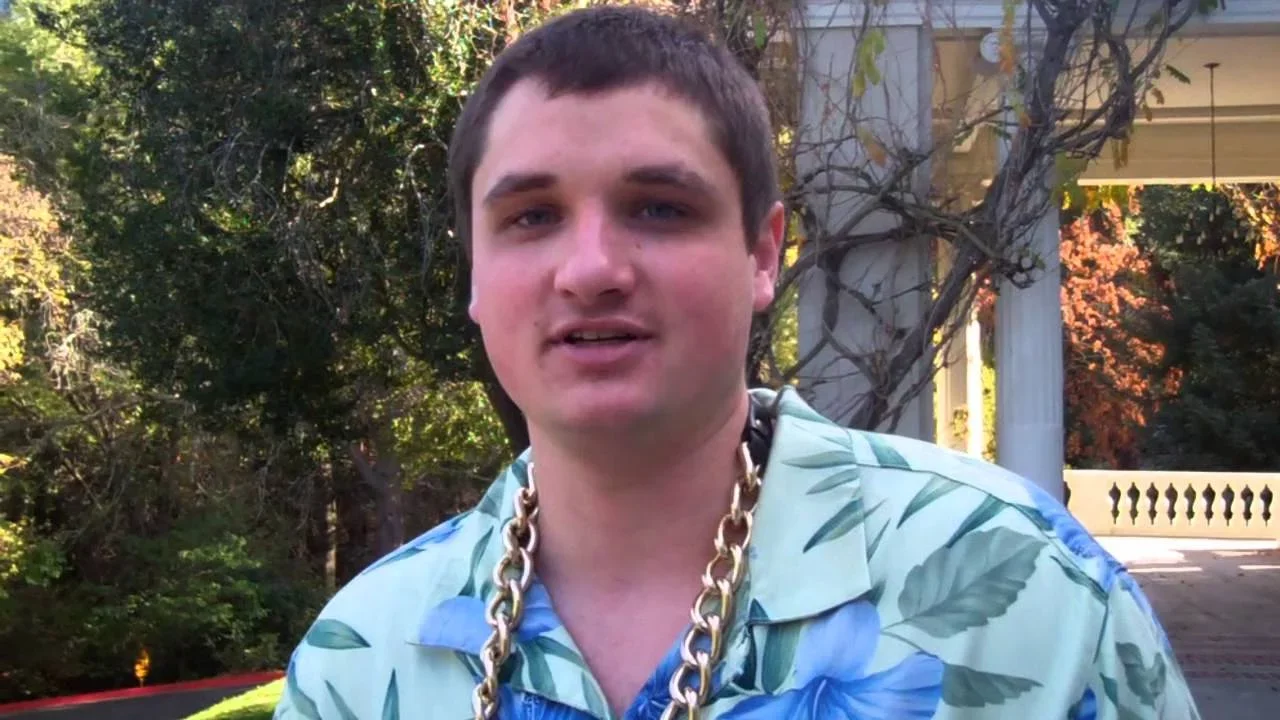
His comically sentimental piano-ballad “I Love McChickens” is just him literally repeating the lines “I love McChickens, I love McChickens/ McChickens love me, McChickens love me” on a loop. His songs and videos were so stupid that they were genuinely hilarious and catchy in their own demented way. In the video for “I DON’T GIVE A HOOT (ZERO HOOTS FREESTYLE),” 3PAC meanders through a shopping mall with toilet paper wrapped around his head and an oversized gold chain hanging on his neck, dancing on food court tables and rapping in coin-operated kids rides that he’s too big to fit into. He flows in a talky, disaffected, stream-of-consciousness delivery with lyrics that feel made up on the spot - over a hollow, repetitive beat that sounds like it was made on an iPad. He even released his own Eminem diss track - “RAP GOD (RIP HARDEST IN THE GAME SON)” - where he declares he’s the "hardest rapper in the game son...Eminem not the real rap god son” in between hacking, lung-clearing verses that sound as if he was suffering through bronchitis while recording. Truly unhinged stuff.
His music was also PACKED with lore. Most notably, he LOVED the word “hoots,” and the act of giving “zero hoots.” This motif became so synonymous with his music that he affectionately referred to his cult fandom as the “ZERO HOOTS GANG,” with countless song titles containing the acronym “ZHG.” On a more problematic level, he flagrantly used the n-word in his early tracks — a decision as offensive as it was performative. (One of his most infamous songs is literally titled “WHITE N****”). But here’s where 3PAC’s art gets slippery: his delivery was so winking, so exaggerated, that audiences interpreted it less as racism than as chaotic satire — the linguistic equivalent of trolling the entire concept of rap authenticity. It doesn’t excuse the language, but it does reveal the strange post-ironic space he operated in, where offense and absurdity were indistinguishable and intent became impossible to parse.
Somewhere along the way, the irony blurred into something real. His songs were still terrible by conventional standards — off-beat, out-of-breath, mixed like static — but they were his, and they hit an undeniable nerve. He started playing small DIY shows, including a legendary college house party in San Luis Obispo that turned out nearly 100 people. Suddenly, the line between ironic comedy and sincere fandom had effectively collapsed. People moshed, chanted his lyrics, and turned his catchphrases into memes. What started as a chronically online joke was now a movement.
Despite the lo-fi chaos, there was charisma in his conviction. 3PAC was both parodying the ego of rap and embodying it. “I don't give a hoot, because I am the Rap God,” he declared — a line that’s either delusional, brilliant, or both. Like Wild Man Fischer decades earlier, his total lack of filter became its own kind of purity. He wasn’t performing irony so much as living inside it. By 2015, he’d built a modest online following, and the laughter had turned strangely affectionate. He was the avatar of an emerging generation of post-ironic creators who refused to separate sincerity from satire. In hindsight, 3PAC felt like clear lineage to the absurdist wing of SoundCloud rap — artists like Lil B, Yung Lean, or Lil Pump, who played with persona, humor, and self-mythology in ways that blurred the boundaries between parody and performance. Whether 3PAC’s output was coincidental or prescient is up to you to decide. Either way, his music popped off at exactly the time that the SoundCloud era was really taking hold.
3PAC stood in stark contrast to other musicians who occupy the outsider sphere. He apparently had a stable, grounded upbringing and personal life, and the music hustle really was just a hobby for him. By all accounts, he was very different from his 3PAC persona - a humble, dedicated friend and water polo teammate who just loved to be a light of positivity and humor in the lives of those closest to him. 3PAC was just that - a vehicle for him to flex and indulge his creative wild side.
But like so many outsiders before him, his story didn’t end in triumph. In October 2015, at just 24 years old, Harryman tragically drowned in a pool during water polo practice at San Jose State University, where he was studying anthropology. His death stunned the same internet communities that had once laughed at (and with) him. Suddenly, the meme had a mortality. The absurdist jester was gone, and what remained was the echo of a very real young man who wanted to be famous — and, in his own way, was.
If Wild Man Fischer was outsider music’s analog madness, 3PAC was its digital mutation: a performer born from the algorithm, uploading unfiltered chaos in real time. His art was ugly, abrasive, often offensive, but it was also fearless — the work of someone who refused to fake polish or restraint. In an era of hyper-curated self-branding, that kind of bare-bones self-belief feels downright radical.
Today, 3PAC’s legacy exists in a strange limbo between meme culture and myth. His videos still circulate, his catchphrases still resurface, and his spirit lingers in the DNA of internet rap — chaotic, funny, self-aware, and occasionally heartbreaking. His four mixtapes - 3PACALYPSE NOW, ZHG TILL INFINITY, 3PAC Of The Caribbean, Insomniac Flows - still simmer in DIY internet rap circles. Hip-hop doesn’t have a whole lot of “outsiders” in the traditional sense - although comedic ones like 22 Savage (and 23 Savage after that) feel like spiritual successors in the way that they also blatantly ripped off/parodied the rap scene of their time. Like all true outsiders, 3PAC was both the punchline and the prophet, the performance and the person.
If The Outsiders had an internet wing, 3PAC would be its first inductee — not because his music was “good,” but because it was unmistakably his. He didn’t need a studio or a label. He just needed a camera, a beat, and a world crazy enough to listen.