THE OUTSIDERS: Farrah Abraham - worst musician ever, or accidental avant-garde genius?
RateYourMusic defines “outsider music” as “songs and compositions by musicians who are not part of the commercial music industry who write songs that ignore standard musical or lyrical conventions, either because they have no formal training or because they disagree with formal rules.”
Typically, this means someone on the margins: the busker, the bedroom visionary, the self-taught misfit whose art is born from obscurity. But what happens when an insider makes outsider art by accident? What happens when fame itself — and the distortion that comes with it — becomes the source of alien expression?
If Wild Man Fischer screamed his way into outsider history from the streets of Los Angeles, Farrah Abraham stumbled into it from the opposite direction: the bright lights of MTV. A reality TV star turned accidental avant-garde auteur, she’s the rare outsider who didn’t claw her way in from the underground — she fell through the cracks of pop culture’s upper crust.
Farrah Abraham’s story begins, fittingly, in front of a camera. Born in Omaha in 1991 and raised in Council Bluffs, Iowa, she entered the public eye at sixteen as one of the original cast members of MTV’s 16 and Pregnant, which chronicled her unexpected motherhood and strained family life. When the network spun the concept into Teen Mom, Farrah became its breakout anti-hero — combative, ambitious, and increasingly self-mythologizing. Reality TV fame warped her adolescence into a commodity, and Farrah, ever determined to stay relevant, learned to see herself not as a person but as a brand. The endless cycle of publicity, controversy, and reinvention seemed to convince her that fame itself was a creative medium — that visibility was the art. By the time she turned to music, she wasn’t chasing a sound so much as a reflection - emulating celebrity contemporaries like Paris Hilton and Heidi Montag - reality TV stars whose forays into pop music blurred self-promotion with self-expression.
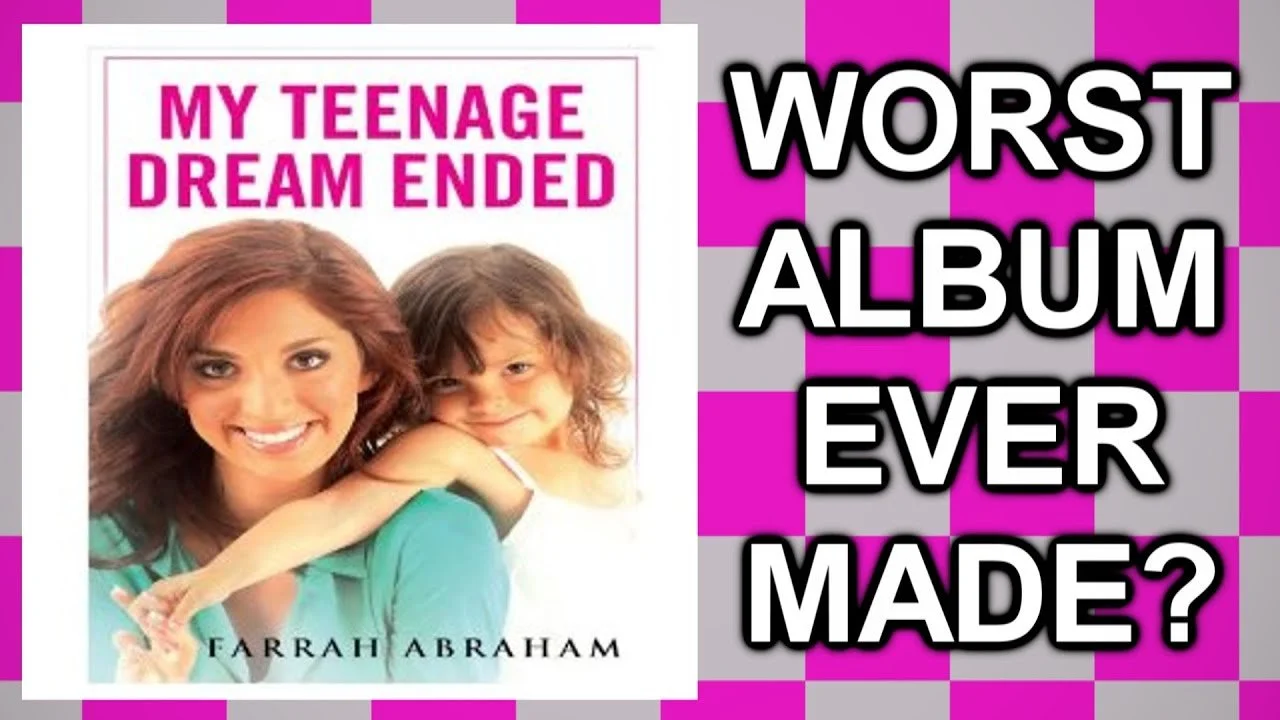
Farrah Abraham’s My Teenage Dream Ended, released in 2012, is one of the strangest pop albums ever made. Issued in tandem with her memoir of the same name, the record was supposed to mark a new chapter for the former Teen Mom star — a chance to rebrand as a pop artist, a voice of empowerment, a woman taking control of her narrative. Instead, it became a surreal, alien artifact — a post-human cry for connection, wrapped in cheap EDM production and industrial-grade Auto-Tune - courtesy of “producer” Frederick M. Cuevas, a sound mixer she met on 16 & Pregnant. The results are equally baffling and fascinating.
On paper, it’s pop. In practice, it’s chaotic nonsense. Abraham’s vocals are so drenched in digital correction they barely resemble human speech — robotic syllables slurred across uneven tempos and wayward synths. Each track feels slightly misaligned, as if reality itself had glitched. The lyrics, though confessional, sound eerily detached: heartbreak, loneliness, betrayal, all filtered through dead eyes and metallic haze. “The Sunshine State” could almost pass for a dance track if it didn’t sound like two songs playing at once. “Unplanned Parenthood” sounds like a voicemail run through a malfunctioning vocoder. And “The Phone Call That Changed My Life” the opener, might be one of the most jarring album intros of all time — a slow-motion collision between diary entry and digital crashout amidst a cacophony of bargain-bin dubstep wubs.
Critics didn’t know what to do with it. Consequence of Sound called it “avant-garde brilliance.” Others called it “the worst album ever made.” In truth, it’s both. My Teenage Dream Ended isn’t just a bad pop record — it’s a perfect outsider record. It’s defiantly artless, utterly immune to conventional taste, and yet somehow deeply sincere. Farrah Abraham was trying to sound like everyone else, and in failing spectacularly, she made something completely her own.
Part of what makes the album so haunting is how unintentional and uncanny it feels. There’s no wink, no irony, no conceptual layer to hide behind. This isn’t satire like 3PAC’s YouTube antics or Daniel Johnston’s childlike whimsy — it’s a celebrity earnestly baring her soul through a machine that doesn’t recognize it. The result is weirdly poignant: a woman turned brand, trying (and failing) to sound human again.
And in hindsight, My Teenage Dream Ended may have been prophetic. Nearly a decade later, a wave of artists — from 100 gecs to Dorian Electra to underscores — would take some of those same hyper-synthetic, pitch-shifted aesthetics and build an entire movement around them. Hyperpop, in its own way, is indirectly the polished reflection of Farrah’s accidental experiment: glossy chaos, Auto-Tuned emotion, technology pushed to emotional extremes. Where Farrah stumbled backwards into distortion, others later found liberation in it.
It’s tempting to laugh at the album — and plenty of people did — but there’s something unshakably human beneath the digital fog. In her voice, flattened and stretched beyond recognition, you can still hear longing. The desire to connect. The same desire that fueled every outsider before her. Farrah’s tragedy isn’t that she made a terrible pop album. It’s that she made a painfully honest one, dressed in the wrong clothes.
If Tres & Kitsy represented innocence and Wild Man Fischer embodied chaotic id, then Farrah Abraham is a cautionary tale for the influencer age. Her art isn’t born of obscurity, but of overexposure; not from lack of access, but from too much of it. She reminds us that outsider music doesn’t always come from the margins. Sometimes, it comes from the center — when the machinery of fame malfunctions and spits out something so insane that it’s accidentally divine.
Farrah Abraham didn’t set out to make outsider art. But in trying to sound like everyone else, she made something that sounded like no one else at all.